The journal · Published on 13 October 2026
A history of stage levitation: how magicians learned to float a human being
Floating a person is probably the oldest dream of the magic stage. In under two centuries it moved from a theatre in the Palais-Royal to a New York pavement, and then into the middle of a banquet hall. Here are the milestones, with their sources, and without a single secret.
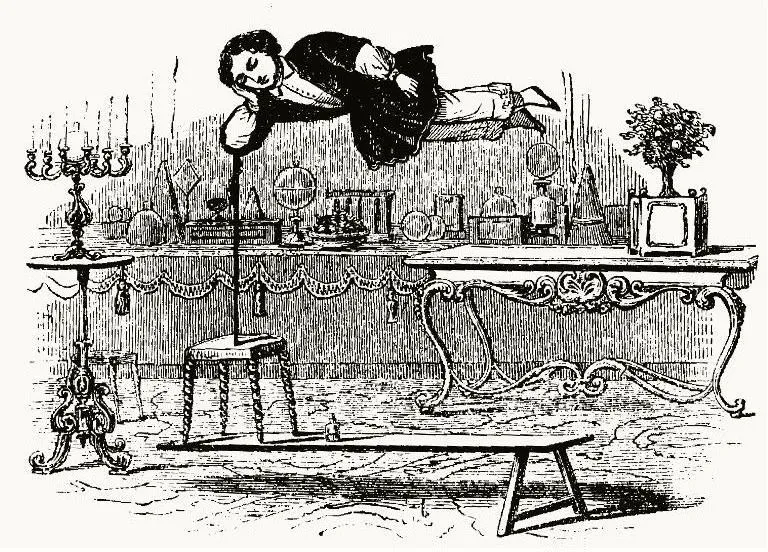
What is human levitation in magic?
In magic, levitation is an illusion: a person, or an object, appears to rise and float without any support. No powers are involved and gravity is not defeated; what you see is an apparatus, a staging and a carefully controlled line of sight. Magicians distinguish suspension, where the body still rests on some absurdly small point of contact, from levitation proper, where it leaves every visible support behind. It is one of the oldest and most requested effects in the repertoire, because it speaks to a dream everyone shares.
For a long time the image was sold as a wonder from far away. An engraving published in 1823 in a book by John Gantz already shows a brahmin from Cuddapah, in India, sitting in mid-air. That exotic setting fed the imagination of magicians throughout the nineteenth century.
1847, Paris: the Ethereal Suspension
On 3 July 1845, Jean-Eugène Robert-Houdin, a clockmaker from Blois, opened his Soirées Fantastiques at the Palais-Royal. Two years later, as he tells it in his memoirs, all of Paris was talking about ether, the new anaesthetic, and he turned it into the Ethereal Suspension. Robert-Houdin pretended to have one of his young sons breathe it in; the boy fell asleep and stayed suspended in mid-air. In his Confidences, he dates the first performance to 10 October 1849.
Ether had nothing to do with it: the vial was empty, and the smell came from a little ether poured onto a heated shovel. Yet the illusion was so convincing that members of the public wrote in, worried about the boy's health. Modern levitation starts here: a scientific pretext, a restrained staging, and invisible engineering.
London, the Egyptian Hall: Maskelyne
At the end of 1873, the Englishman John Nevil Maskelyne, also a trained watchmaker, moved into the Egyptian Hall in Piccadilly with his partner George Alfred Cooke. They stayed for more than thirty years, until the hall was demolished in 1905. Among their creations was a floating lady, which Maskelyne kept refining.
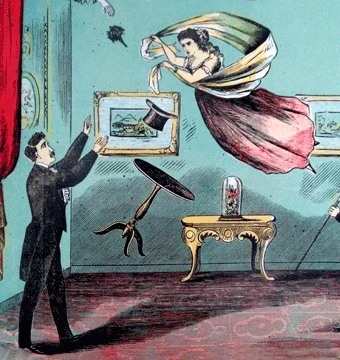
With him, levitation became a true theatrical grand illusion: a person rises in the middle of the stage with no visible support. Levitation is in fact often wrongly credited to Robert-Houdin, when its stage form owes most to Maskelyne.
Kellar, Princess Karnac and the stolen secret
Across the Atlantic, the American Harry Kellar (1849-1922) presented the Levitation of Princess Karnac: his partner, billed as an Indian princess, floated above a bare stage. It remains one of the most famous acts in the history of magic.
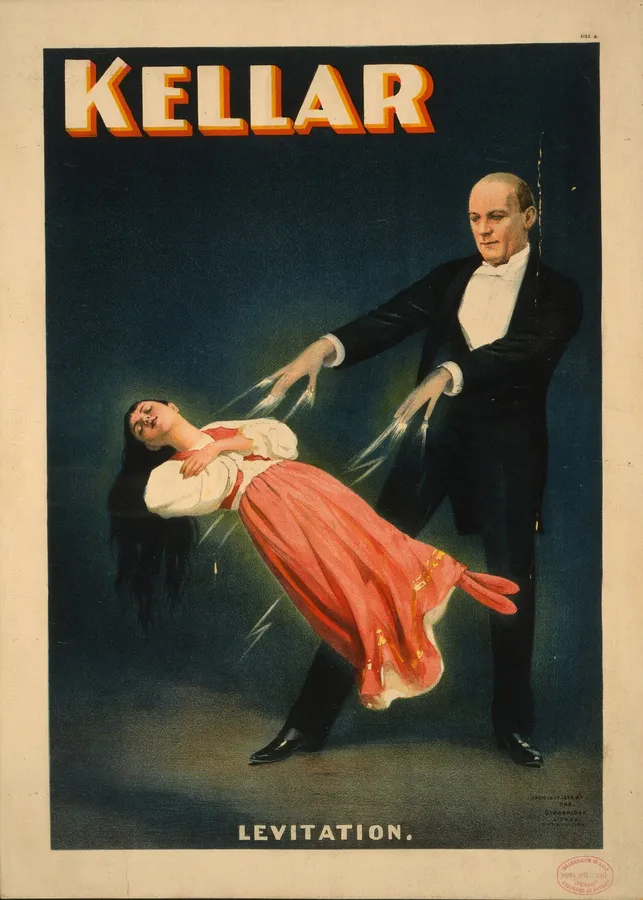
Its origin is disputed. One account says Kellar walked abruptly onto Maskelyne's stage during a show, just long enough to see what he needed. Another, reported by the historian Jim Steinmeyer, says he bought the secret by bribing one of Maskelyne's technicians, Paul Valadon. Unable to reproduce the apparatus, Kellar hired another magician to help, then designed a new version with the Otis elevator company.
Le Roy and Asrah: the lady who vanishes in mid-air
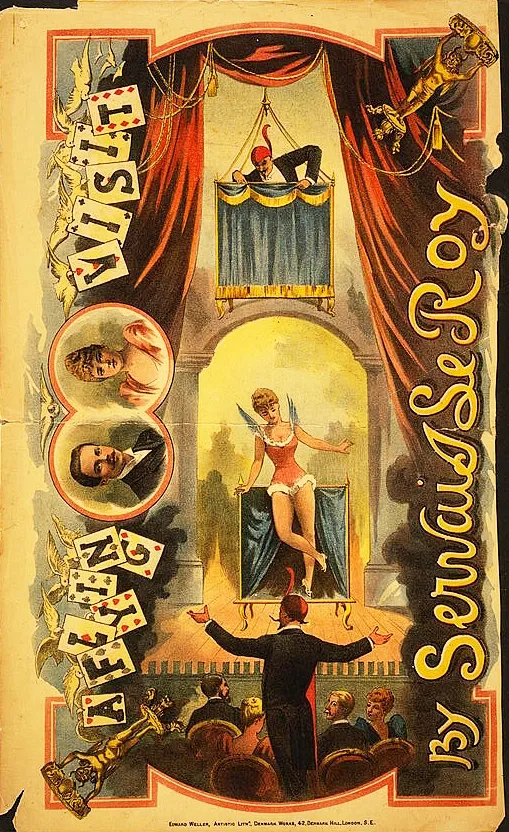
In the early twentieth century, the Belgian Servais Le Roy (1865-1953), magician and illusion designer, created the Asrah levitation with his wife Talma. Covered with a sheet, Talma rose into the air; Le Roy pulled the sheet away, and she was gone. Sources disagree on the date of its creation, somewhere between 1902 and 1914, but the idea of a levitation that ends in a vanish shaped everything that followed.
Thurston: levitation on tour
When Kellar retired, he named Howard Thurston as his successor. Thurston took over Princess Karnac and carried it across the United States in a show so large that it needed eight railway cars to move it. Levitation was then a piece for the very largest stages, reserved for companies able to carry it.
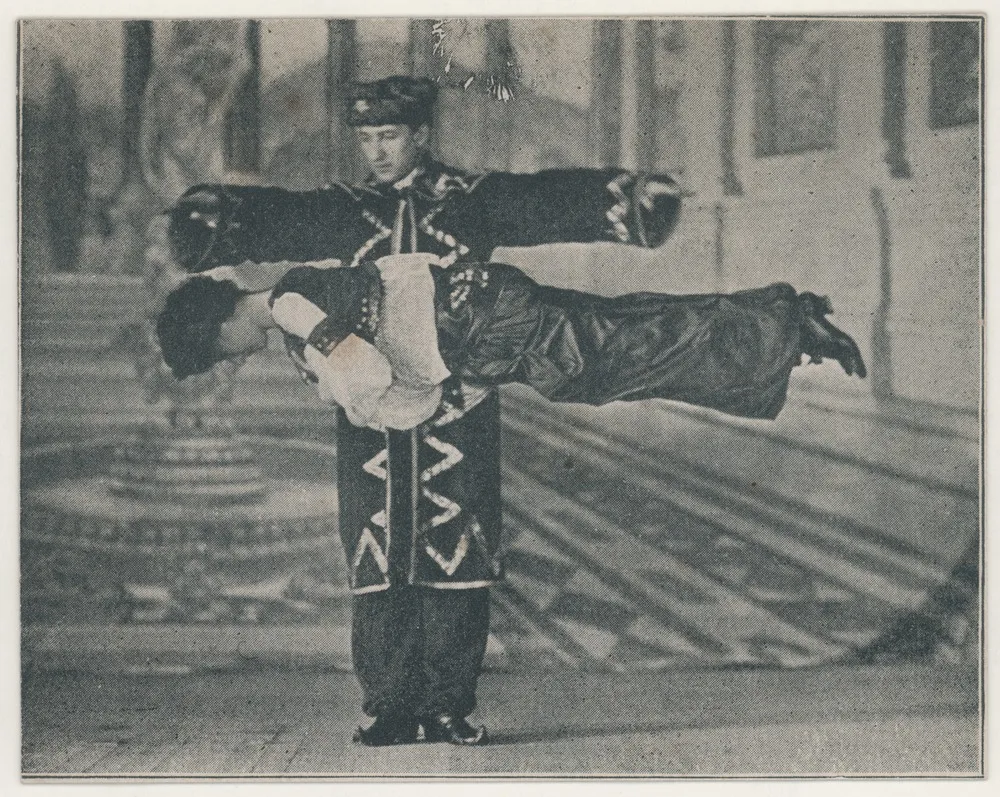
1974: levitation takes to the street
In July 1974, Ed Balducci described an impromptu levitation, needing no apparatus at all, in The Pallbearer's Review under the title Impromptu Levitation. He noted himself that the originator was unknown. This levitation, known ever since as the Balducci levitation, was popularised much later on television, notably by David Blaine.
For the first time, levitation left the theatre. It was performed two metres from people, with no set, and that closeness is exactly what makes it so strong.
1992: Copperfield takes flight
In the 1950s, Peter Foy, unhappy with the flying in a production of Peter Pan, perfected his own system and founded Flying by Foy in 1957. Building on that work, the inventor John Gaughan created Flying, which David Copperfield has performed since 1992: the magician flies on stage, with no visible support. Gaughan went on to patent the technique in the United States in 1994, reportedly against Copperfield's wishes.
Northern France: Yogano, then Spontus
In France, in 1982, at the Nancy convention, the inventor Yogano won the Magicus grand prize with a vertical bar stool levitation. He then published a book of grand illusions. Reading it, Olivier Guernion, a magician and inventor based in the Oise who signed his work Spontus, had the idea of combining two of those illusions. The result was the Spontus 360, the first levitation of a spectator visible from every side. We tell that story in detail in our article “Where Air360 comes from”.
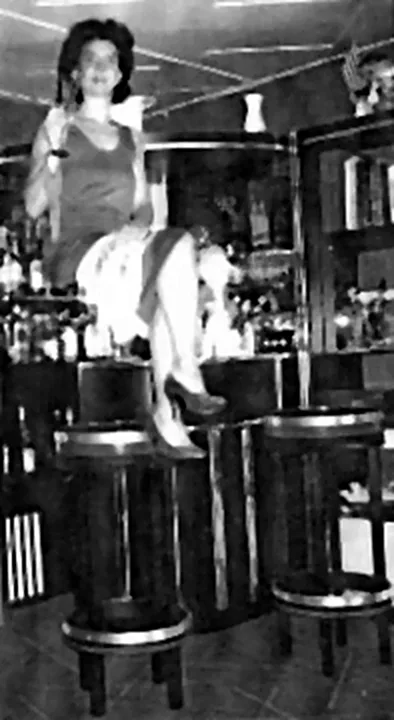
Today: a spectator, surrounded by the audience
The movement has been constant for two centuries: levitation leaves the distant stage and moves closer to people. The latest step is to float not an assistant but a member of the audience, with spectators all around. That is what Air360 does, the levitation we build in Lyon, a direct descendant of the Spontus 360.
So how does it work?
You will not read it here. The methods behind stage levitations are passed from magician to magician, sometimes under a non-disclosure agreement, and revealing them would take away from audiences the very thing that gives them value: not knowing. What history does show is that every generation has had to invent a new solution, because audiences learn too.
Sources
- Robert-Houdin, Confidences et révélations : comment on devient sorcier (1868), chapitre « La suspension éthéréenne » (Gallica) : l’idée née en 1847, première représentation le 10 octobre 1849.
- Wikipédia, notice « Jean-Eugène Robert-Houdin » : Soirées fantastiques ouvertes le 3 juillet 1845 au Palais-Royal.
- Wikipedia (EN), « Jean Eugène Robert-Houdin » : la Suspension éthéréenne et le prétexte de l’éther.
- Illustrations : Library of Congress, Wikimedia Commons et affiche de Maskelyne, toutes dans le domaine public.
- BnF, Les arts du cirque, « Levitation » : gravure de John Gantz (1823), Maskelyne et Cooke à l’Egyptian Hall (1873), Peter Foy et Flying by Foy (1957), John Gaughan et Flying (1992).
- Wikipedia (EN), « John Nevil Maskelyne » : Egyptian Hall de 1873 à 1905, lévitation, accusation rapportée par Jim Steinmeyer (Hiding the Elephant) contre Kellar.
- Wikipedia (EN), « Harry Kellar » : Lévitation de la princesse Karnac, version conçue avec Otis, succession de Thurston.
- Wikipedia (EN), « Servais Le Roy » et « Levitation (illusion) » : Asrah, avec Talma (dates divergentes : 1902 et 1914).
- Wikipedia (EN), « Howard Thurston » : princesse Karnac, spectacle transporté dans huit wagons.
- Wikipedia (EN), « Balducci levitation » : description par Ed Balducci, The Pallbearer’s Review, juillet 1974, « originator unknown ».
- Wikipedia (EN), « Levitation (illusion) » : Flying de David Copperfield depuis 1992, brevet américain 5 354 238 de John Gaughan (1994).
- Yogano Magie, entretien en ligne : grand prix Magicus 1982, lévitation verticale sur tabouret.